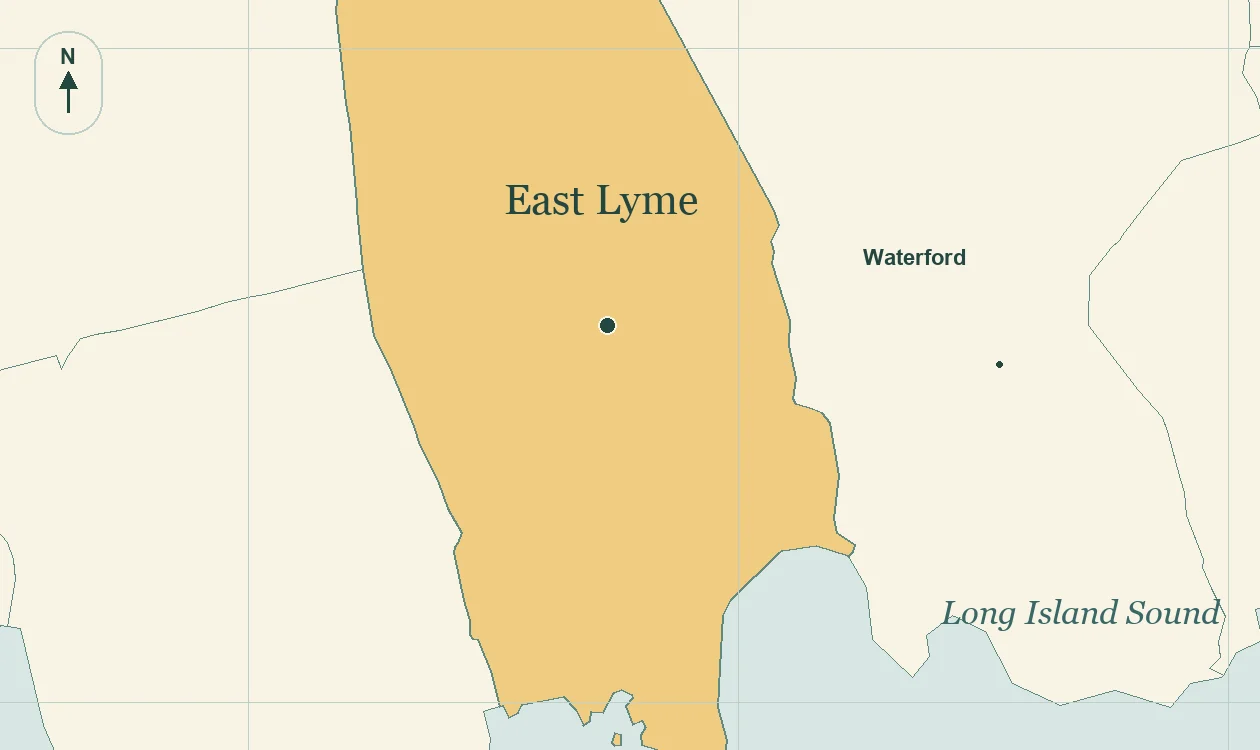
Find out who zones your lot before you compare quotes
East Lyme's Building Department page says some Niantic properties sit in separately zoned beach districts that need their own zoning approval, such as the Giants Neck Beach Association, the Crescent Beach Association and Black Point. Those districts write their own solar rules, and two of them point in opposite directions. Which one governs your lot changes what you file, when work can start and where backup equipment can go.
What we could confirm:
- Giants Neck. The Giants Neck Beach Association zoning regulations (effective December 15, 2025) say all solar panels require a zoning permit. Panels must be attached to the roof of the house or an accessory structure and follow the roofline. Panels that rotate to follow the sun are not permitted.
- Black Point. The Black Point Beach Club Association regulations (dated October 15, 2026) waive the zoning permit for roof-mounted solar panels. Ground-mounted panels count toward building coverage.
- Crescent Beach. The town lists it among the districts that need their own zoning approval, and it has its own zoning enforcement officer (ZEO), the person who checks projects against the district's rules and signs off. We could not confirm its current solar rules. Ask the ZEO before you sign.
- The rest of town. Town zoning governs. We could not read whether a roof array outside the beach districts needs a town zoning permit, so ask the Zoning Department directly.
The town names these districts as examples, so do not assume they are the only three.
How to settle it for your address:
- If you belong to a beach association or receive its notices, ask its zoning officer whether your lot is in the district and what a solar application needs.
- Pull your property's field card from the town's Vision Appraisal records. You will need it anyway: Giants Neck asks for the assessor's card with every zoning application.
- Ask the town Zoning office two questions: "Is my address in a separately zoned beach district?" and "Does a roof-mounted solar array need a town zoning permit here?"
Write down who answered and when. That answer goes at the top of your quote checklist, because every installer you talk to should be designing for the same set of rules.
East Lyme's permit route: MGO Connect, zoning review and extra sign-offs
The East Lyme Building Department works out of Town Hall at 108 Pennsylvania Avenue in Niantic. Its page links online building permits through MGO Connect, and inspections are scheduled through the same portal. The town's site would not load for our checks on November 18, 2026, so these details come from its own pages as archived earlier in 2026. Confirm the portal and fee before you file.
Every building permit gets a zoning check. The town says each permit is reviewed by the building official and the zoning official, plus a Tax Collector check.
The fee follows the value of the job. The town's fee rule is $30 for the first $1,000 of construction value, plus $15 for each additional $1,000 or fraction, plus the State Education fee. The value must include all materials and labor, electrical work included, and the building official sets the final valuation. If a battery is written into the same job, it raises the value, and with it the fee.
The solar form shows the battery. The town posts the Connecticut Standardized Solar PV Permit Application Supplement. Its site plan must show the panels, inverters, main panel, utility meter, AC disconnect, any batteries, property lines, setbacks and trenching. The one-line electrical drawing must show battery type, quantity and kWh. The town notes that its handouts predate the October 2022 building code, so ask your installer which current version they will file.
Your lot can add approvals on top of the building permit:
| If your lot… | Extra approval | What it decides |
|---|---|---|
| Sits in a beach district | That district's zoning approval | Whether the array is allowed as designed, and when work can start |
| Is within 300 ft of a wetland or watercourse | Possibly an Inland Wetland Permit (agent or agency approval) | Whether work near the water needs wetlands sign-off |
| Has a private septic system or well | Ledge Light Health District B100a application | The health district's review of building work on a septic or well lot |
| Is in a flood hazard area | Floodplain Development Permit | The town records your flood zone and 100-year flood elevation |
| Any job | Eversource clearance after inspection | The town says to allow at least 48 hours |
Flood routes differ even next door. Across the Niantic River, Waterford requires a zoning compliance permit before development in a flood hazard area; our Waterford page covers that route. In East Lyme, the flood step runs through the Building Department's Floodplain Development Permit.
The steps an East Lyme job goes through
We found no published total timeline for an East Lyme solar job. The calendar depends on which of these steps apply to you, roughly in this order; the building permit and the Eversource application run as separate tracks:
- Settle the zoning body and the flags (wetlands, septic or well, flood hazard area) before anyone designs the array.
- Get any beach-district approval before work starts. Giants Neck wants a complete package by the 1st for that month's meeting on the second Saturday, and adds a surcharge if work starts before approval. Black Point's commission meets on the 3rd Friday.
- File the building permit through MGO Connect, where it gets the building, zoning and Tax Collector checks.
- Apply to Eversource for interconnection. This is a separate application from the building permit, and it is where you make the tariff election described below.
- Install, then inspect through MGO Connect.
- Wait for Eversource clearance, at least 48 hours after inspection, per the town.
- Enroll the battery in Energy Storage Solutions, if you take backup.
If an installer quotes a week count, ask which of these steps it assumes and which dates it depends on.
What the proposed service would put in writing
Proposed service. New London Solar is a proposed solar service for New London-area homeowners. Coverage of East Lyme is proposed and not yet confirmed. Our home page explains the idea: keep everyday solar and outage backup apart so you can judge each one on its own numbers.
In East Lyme that split follows the approvals. The roof array is the part Giants Neck permits and Black Point waives. The battery, inverter and transfer equipment are the parts that raise siting, flood-height and screening questions. Pricing them together hides both.
The proposed assessment would take about two hours on site (Illustrative example). You would bring 12 months of kWh usage and your field card. The assessor would review roof and shade, the electrical panel, the zoning body and flood flags you confirmed, candidate battery locations and their flood exposure, and the circuits you want running in an outage.
You would get two separate written quotes:
- Quote A, solar only. A roof layout drawing, panel count, DC kW, panel and inverter models, an annual kWh estimate with the shade assumptions stated, the total price and the price per DC watt, which Eversource tariff option it assumes, and who files the permit and the utility application.
- Quote B, optional backup for selected circuits. Your critical-loads list (the circuits you want powered in an outage), circuit by circuit, plus what stays off. Usable kWh, continuous kW and surge kW. Runtime under stated assumptions. Subpanel or transfer work, the battery location, and your Energy Storage Solutions enrollment and event reserve setting.
Two sheets would come with both. A circuit map labels which breakers are backed up. A responsibility sheet names an owner for each step in the sequence above that applies to your lot: the MGO Connect filing and inspections, the beach district ZEO, the wetlands agent, Ledge Light, the Floodplain Development Permit, the Eversource application and tariff election, and ESS enrollment.
Check Quote A by its price per watt
Price per watt is the solar price divided by the array's DC capacity in watts. DC capacity is the combined rating of the panels, the kW figure on the quote. Dollars per watt lets you compare quotes of different sizes on one scale.
Do the math in this order:
- Take the solar-only total. Remove any battery, backup subpanel or transfer work, roof repair, main panel upgrade or generator inlet.
- Convert the system size to watts (for example, 8.0 kW = 8,000 W).
- Divide.
Then compare the result. EcoGen's Connecticut figure is $2.80/W (State benchmark), described in the EcoGen Solar Cost Index methodology as a modeled installed price per watt for a representative residential system, before incentives (September 2026 Edition, prices as of September 25, 2026). It is a model, not a quote. EcoGen's Connecticut cost page puts typical written quotes at $2.46 to $3.14 per watt (State benchmark range). EcoGen does not say whether its figure is per DC or AC watt, so treat it as a sanity check, not a verdict.
Treat the range as a prompt for questions rather than a pass mark. A quote inside it still has to match its own drawing and production estimate. For anything above $3.14/W, ask for a line-by-line explanation.
Check the production estimate the same way. EcoGen's Connecticut cost page models 1,294 kWh per year for each kW of panels. For an 8.0 kW array that works out to about 10,350 kWh a year (Illustrative calculation). Roof direction and shade move that number, so Quote A should state its own estimate and the shade it assumed. If the estimate sits well above the statewide figure, ask how they got there.
The split matters twice in East Lyme. The battery distorts the solar $/W. It can also move the fees, because the town values the whole job for the building permit and a beach district charges by construction value. The worked example shows both.
Worked example: one quote pair, two beach lots
Illustrative example: two hypothetical Niantic beach-district homes, same two proposals.
- Quote A, solar only (Illustrative example): 8.0 kW DC roof array, 20 panels at 400 W, $23,600.
- Quote B, backup for selected circuits (Illustrative example): one 13.5 kWh battery at EcoGen's modeled Connecticut price of $13,500, plus $2,400 of critical-loads subpanel and transfer work (illustrative), for $15,900.
- Combined (Illustrative example): $39,500.
Step Giants Neck lot Black Point lot District zoning permit for the roof array Required: roof-attached, follows the roofline, no tracking panels Waived for roof-mounted panels District fee if the array is filed alone at $23,600 (Illustrative calculation) $150 bracket ($10,001–$25,000) No permit needed for the array District fee if Quote B is in the same application at $39,500 (Illustrative calculation) $300 bracket ($25,001–$50,000) Ask the ZEO whether a battery needs a permit. If it does, $15,900 falls in the $300 bracket ($10,000 to under $50,000) Timing Complete package, in duplicate with site plan and assessor's card, due by the 1st; reviewed at the meeting on the second Saturday Commission meets on the 3rd Friday, if a permit is needed Starting early Surcharge if work starts before approval Triple fee if work starts without a permit Town building permit, both lots (Illustrative calculation using the town's fee rule): Quote A alone at $23,600 = $30 + (23 × $15) = $375. Quotes A and B together at $39,500 = $30 + (39 × $15) = $615. Both figures are plus the State Education fee, and the building official sets the final valuation.
Quote check (Illustrative calculation vs State benchmark): $23,600 ÷ 8,000 W = $2.95/W, inside the $2.46–$3.14 range and about 5% above the $2.80/W State benchmark. Divide the $39,500 total by the same 8,000 W and you get $4.94/W (Illustrative calculation). That looks like an overpriced solar quote. It is a fair-looking solar quote with a battery stacked on top.
Three things follow from the example.
The $4.94 figure is the trap. With one combined price, you cannot judge the solar part at all. Ask any installer who hands you a single number to split it before you compare.
The extra town fee belongs to the battery. The $240 difference in building permit fees ($615 minus $375, Illustrative calculation) is the fee on the battery work. It sits with Quote B and should drop away if you decline backup.
At Giants Neck, splitting buys time more than money. A bundled application lands in the $300 bracket. If the battery later needed its own district permit, its $15,900 would fall in the $150 bracket (Illustrative calculation), so the district total could come out the same. The gain is that the array's approval need not wait on a battery you have not decided on. Miss the 1st with an incomplete package and the next review is the following month's meeting.
Quote B on a shoreline lot: placement, flood height and storm reserve
The panels go on the roof. The battery, inverter and transfer equipment have to sit on the ground, on a wall or inside, and on a beach lot each of those spots has its own question.
Where the equipment can go
Both districts regulate what they call exterior accessory equipment: fixed outdoor heating, air-conditioning, fuel-storage and pool equipment not attached to the house.
- Giants Neck: not in the front yard, at least 6 ft from the property line, and screened by evergreen plantings or fencing. Fences need Zoning Commission approval there, so screening can turn into its own application.
- Black Point: not in the front yard, no more than 3 ft into a setback, never closer than 5 ft to the property line, and screened.
Neither definition names batteries or inverters. Ask the ZEO, in writing, whether a pad-mounted or wall-mounted battery counts as exterior accessory equipment on your lot. Do not assume a wall-mounted unit is exempt, and do not assume a battery always needs a permit. Get the answer before Quote B is final, because it can move the battery from the side yard to the basement, and that brings in the next question.
Height versus the flood elevation the town records
If your lot is in a flood hazard area, the town's Floodplain Development Permit records your Special Flood Hazard Area status, your FIRM zone (the zone on the federal flood map) and the 100-year flood elevation. Ask your installer three questions:
- Where will the battery, inverter and transfer switch sit relative to that elevation?
- Will the site plan show the elevation next to the equipment?
- If the basement or garage sits below it, where else could the equipment go, and do the district's setback or screening rules apply there?
If no spot on your lot clears both the district rules and the flood height, Quote B should say so before you pay for a battery.
Storm reserve versus ESS events
Energy Storage Solutions (ESS) is the state battery program for Eversource and UI customers, enrolled through an eligible contractor. For applications on or after April 1, 2026, the ESS program changes set a residential upfront incentive of $30 per kWh, so a 13.5 kWh battery would earn $405 (Illustrative calculation). A performance incentive of $300 per kW per year follows for 10 years, higher for underserved and low-income customers. The battery discharges during roughly 50 summer and 5 winter events, and opting out of events reduces the performance payment.
That is a real trade-off for a shoreline household. Every event draws down charge you might want held for a storm outage. Quote B should state, in writing, how much charge the battery keeps in reserve during events and what that setting means for the ESS payment.
What goes on the critical-loads list
Start with what must run in an outage: refrigerator, sump pump, well pump, boiler or furnace controls, medical devices, Wi-Fi and a few lights. Sump and well pumps are motor loads with a high starting surge, so check that Quote B lists surge kW, not only continuous kW.
If another installer offers "whole-home backup", hold it to the same questions: which circuits, at what continuous and surge kW, for how long, under which stated assumptions. Compare the two on those answers, not on the label.
What Eversource pays for the solar
East Lyme, from Flanders to the Niantic shore, is Eversource territory. Unlike Groton, it is not on the state's list of towns that run their own electric service. Check the name on your bill anyway.
New Eversource solar customers choose between two options under the Residential Renewable Energy Solutions program (RRES). For applications submitted in 2026, Buy-All pays $0.3289 per kWh for everything the array produces, while you keep buying all your power at retail. Netting credits exported power at the full retail rate but charges $0.0402 per kWh on all production, so its value moves with your retail rate. EcoGen's Connecticut solar incentives page lists the same Buy-All and Netting rates alongside the ESS battery incentives.
The election is made at interconnection and fixed for 20 years. Homes with one to four units are capped at 25 kW. The PURA program page lists the decision that set 2026 rates, and 2027 rates had not been set as of November 18, 2026. State law extends RRES to December 31, 2028, or earlier if a successor program launches.
Because the choice locks for 20 years, ask Quote A to model both options against your 12 months of usage and say which it assumes. If your interconnection application may land in 2027, ask how the quote will change once the new rates are published.
One federal point: the Residential Clean Energy Credit does not apply to systems placed in service after December 31, 2025. Any quote that counts a federal credit for a 2026 or 2027 home installation needs correcting.
Bring this to an East Lyme quote
Bring these, or send them ahead. The quote checklist on this site follows the same list.
About the lot
- Your zoning body: town zoning, Giants Neck, Black Point, Crescent Beach or another district, with the name of whoever confirmed it.
- Your property field card from Vision Appraisal.
- Flags: within 300 ft of a wetland or watercourse, private septic or well, flood hazard area.
About the roof and house
- Roof age and any past permits. East Lyme's building street files are kept on paper only and must be searched in person, with no answers by email or phone. If you lack your own records, make that visit before the quote.
About your power
- Your Eversource bill and 12 months of kWh usage.
- A first draft of your critical-loads list, if you want Quote B.
What to ask the installer to put in writing
- A site plan that marks the panels, inverter, battery, conduit routes and setbacks, as the state solar supplement requires.
- Who files each approval: MGO Connect permit and inspections, beach district, wetlands, Ledge Light, floodplain, Eversource application, RRES election and ESS enrollment.
- The flood elevation next to any ground-level or basement equipment.
- Quote A and Quote B as separate prices, each with its own permit valuation.
Questions to ask before you sign
- What license do you hold? Solar electrical work in Connecticut needs a PV-1 contractor or E-1/E-2 license, plus Home Improvement Contractor registration. The Department of Consumer Protection's solar trades page explains which license covers which work. Ask for both numbers.
- Who does the work? Ask whether roof, electrical and trenching work goes to subcontractors, and who answers for workmanship problems, for how long.
- Can I accept Quote A and decline Quote B without the solar price changing?
- Who pays if work starts early? Giants Neck adds a surcharge if work starts before approval, and Black Point triples the fee if work starts without a permit. The contract should say who carries that cost.
- Who files the state tax forms? EcoGen's Connecticut incentives page lists a sales tax exemption through Form CERT-140 and a property tax exemption through Form M-44, filed with the town assessor by November 1. Confirm both with the East Lyme assessor before you count on them.
- Was this a door-to-door pitch? From February 15, 2027, residential solar and storage sellers may solicit in person only between 9 am and 7 pm, and must report their sales partners to the Department of Consumer Protection. A seller at your door outside those hours after that date is breaking the rule, which tells you something about the rest of the pitch.